It started with a question our youngest asked after a dentist appointment: why does the dentist want to know if he gets headaches? We had no good answer at the time, and that small moment sent us looking into something we had never really thought about. What we found changed the way our whole family thinks about teeth, because the mouth turns out to be far more connected to the rest of the body than most of us were taught.
The Mouth Is Not a Separate System
Most of us grew up treating the dentist and the doctor as two unrelated appointments. One looked after your teeth, the other looked after everything else, and the two rarely spoke. That separation is starting to look out of date.
A 2026 review found that problems in the mouth can have effects well beyond it, and argued that oral health should matter to every doctor, not only dentists [1]. A large 2025 study of nearly 14,000 adults found that people with gum disease were more likely to have diabetes, and people with tooth decay were more likely to have high blood pressure [2]. These studies show a link rather than a cause, but the link keeps turning up.
Part of the reason seems to be inflammation. When bacteria irritate the gums, the body sends out chemical messengers to deal with it, a bit like alarm bells ringing through the bloodstream. Those alarms do not stay in the mouth, and researchers believe that over time they may add to the load on other parts of the body, including the heart and the way we handle blood sugar [3].

Teeth as Windows: The Meridian Connection
Traditional Chinese medicine has long used a meridian tooth chart, a map that links each tooth to particular organs through the body's energy pathways. In that framework, an upper molar sits on the same line as the stomach and spleen, and a lower wisdom tooth connects to the heart and small intestine [8].
Western medicine is cautious about meridian theory, and we think that caution is fair. What we find interesting is that modern research is arriving at a similar idea by a completely different route. A 15-year study published in 2025 suggested that tooth loss can be an early sign of broader health changes, and described the mouth and gut as constantly influencing each other [4].
For parents, this is a useful way to look at a child's health. If a child keeps getting ear infections, a blocked nose or unexplained tiredness, it can be worth asking whether the mouth plays a part. Biological and integrative dentists, sometimes called holistic dentists, look for exactly these connections rather than treating each symptom on its own [11].
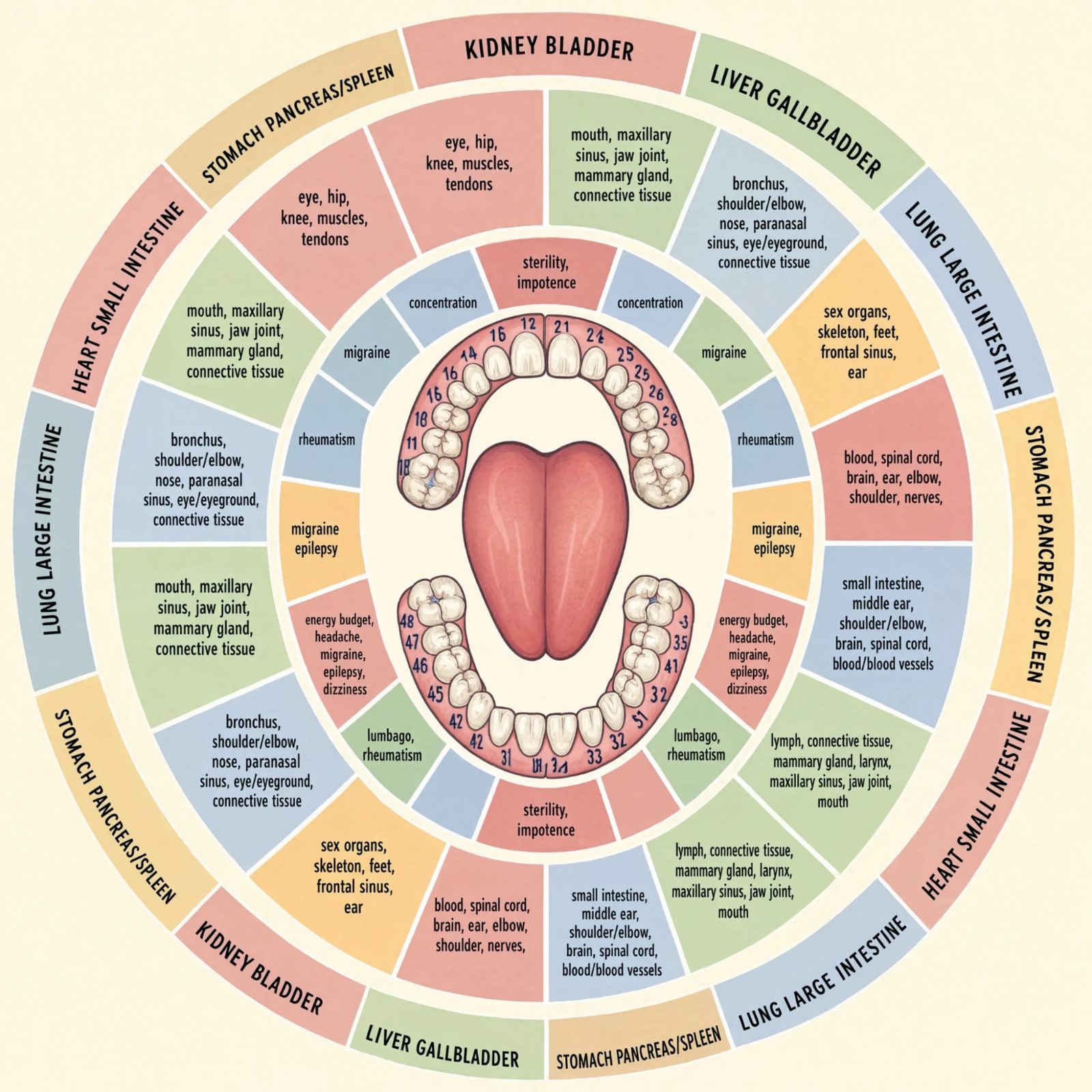
When the gums are inflamed, the alarm signals do not stay in the mouth. Your dentist and your doctor have always been looking after the same person.Mr Wellness
What Quantum Dentistry Actually Means
Quantum dentistry sounds technical, but the idea behind it is simple: find the early signals before a problem becomes a cavity or shows up on an x-ray. A 2025 paper proposed that some processes in the mouth may involve quantum effects at the level of our cells, and called for new tools that could make dentistry more predictive and personal [7]. It is a young and evolving field, and we say that honestly.
We have experienced this approach firsthand with Dr Jalal Khan, who describes what he calls the Quantum Kid. His idea is that a child's dental health should be looked at through the usual clinical lens and also through how the mouth, inflammation, the immune system and, in his view, the body's energetic pathways work together from an early age. The aim is to notice small signals early, well before years of low-grade gum irritation can build up.
In practice, quantum dentistry sits close to biological dentistry, which favours biocompatible materials, gentle techniques and care that considers the whole body [9]. The quantum side adds newer technology that looks for feedback conventional dentistry does not usually measure. We see it as an emerging approach worth watching rather than a finished science.

Chronic Infection, Inflammation and the Family Health Picture
A dental problem that seems minor, such as a low-grade abscess, a troubled root canal or gums that stay inflamed, can keep the body's defences working quietly in the background. Research has found a clear association between dental infections and a range of other health problems [5]. Researchers at Harvard have also noted that poor oral health may make existing conditions like heart disease and diabetes harder to manage [6].
So gum disease and tooth decay are worth taking seriously, not just when they start to hurt. Biological dentists look at ongoing gum problems in the context of inflammation across the whole body, using approaches such as ozone therapy and minimally invasive treatment that aim to deal with the source rather than only the immediate problem [12]. Groups like the International Academy of Oral Medicine and Toxicology continue to research this connection [10].
Gum inflammation has been associated with heart problems and pregnancy complications, and researchers are now exploring possible links with Alzheimer's disease. Holistic dentists look at long-term gum problems alongside hormones, metabolism and overall wellbeing rather than as an isolated mouth issue [11]. When we started seeing our own family's dental care this way, our conversations with the dentist changed completely.
What This Looks Like in Practice for Your Family
Taking a more whole-body approach to your family's teeth does not mean changing everything at once. It starts with better questions. Ask your dentist whether they consider how the mouth affects the rest of the body, and whether biocompatible materials are available for any fillings.
If your child has health issues that keep coming back, it may be worth asking a biological or integrative dentist to look at the mouth as part of the picture. The daily habits at home stay the same: brushing, flossing, less refined sugar and plenty of nutrient-dense food to support a healthy mouth. What changes is why you do them, because looking after the mouth is looking after the whole body [4].
In our house, we think about cleaning teeth the way we think about sleep and food. It is not a box to tick before bed but a genuine act of care. Your teeth are not separate from your body, and in a very real sense, they help tell its story.
At Pristine Wellness, we follow the evidence and share what we have experienced ourselves. If you are building a more preventive approach to your children's health, the mouth deserves a place at the same table as nutrition, sleep and movement. We would encourage you to look into biological and integrative dentistry in your area and to start asking the questions that connect the whole picture.

Sources
- 1.Oral and Systemic Diseases: Critical Relationships Between Human Health, Tooth Decay, Periodontal Diseases and Multidisciplinary Care , PubMed / Bioscience Journal of Human Medicine (2026)
- 2.Investigating the link between oral health conditions and systemic diseases: A cross-sectional analysis , Scientific Reports / Nature (2025)
- 3.Investigating the link between oral health conditions and systemic diseases: A cross-sectional analysis - PMC Full Text , PMC / Scientific Reports (2025)
- 4.Longitudinal Analysis of Tooth Loss as a Biomarker of Systemic Health: Insights From a 15-Year Study of 35 Patients , PMC / Frontiers in Dentistry (2025)
- 5.The oral-systemic disease connection: a retrospective study , PubMed
- 6.Systemic diseases and oral health , PubMed / Dental Clinics of North America - Harvard School of Dental Medicine (2014)
- 7.Quantum biology and non-equilibrium quantum thermodynamics of oral bio-networks: A paradigm shift in predictive, preventive and personalized dentistry , International Journal of Science and Research Archive (2025)
- 8.Integrative Biological Dentistry - Holistic Approach to Oral Health , Integrative Dental Care (Practitioner Resource)
- 9.Biological Dentistry: A Holistic Approach to Oral Health , Wellrooted Biological Dentistry (Practitioner Resource)
- 10.What Is Biological Dentistry? A Natural Approach to Oral Health , Virginia Dental Group / Holistic Dental Association Resource (2025)
- 11.Holistic Dentistry: A Whole-Body Approach to Oral Health , South Lake Dental - Holistic Dentistry Resource (2025)
- 12.The Future of Dental Care: Holistic, Integrative, and Biological Dentistry for Total Wellness , Dental Excellence Integrative Center (2025)